Area Lights
An area light emits from a surface instead of a single point: a rectangle, a disk or a tube. Its specular highlights take the shape of the emitter, and its light wraps softly around objects close to it, which makes windows, ceiling panels, softboxes and fluorescent tubes look right where a point or spot light would leave a tiny, hard highlight.
Plasma has three area light components. They shade with linearly transformed cosines (LTC), an analytic approximation of the light an area emitter casts on a surface.
| Component | Shape | Emits | Use for |
|---|---|---|---|
| Rect Light | Rectangle, Width × Height | One face along the local −X axis, or both with TwoSided | Windows, panels, softboxes, screens. Supports cookies and video. |
| Disk Light | Circle, Radius | One face along the local −X axis, or both with TwoSided | Round ceiling lights, downlights, recessed spots, round softboxes. |
| Cylinder Light | Tube, Radius × Length along the local Y axis | All around the tube, plus the ends with EndCaps | Fluorescent tubes, neon, light bars. |
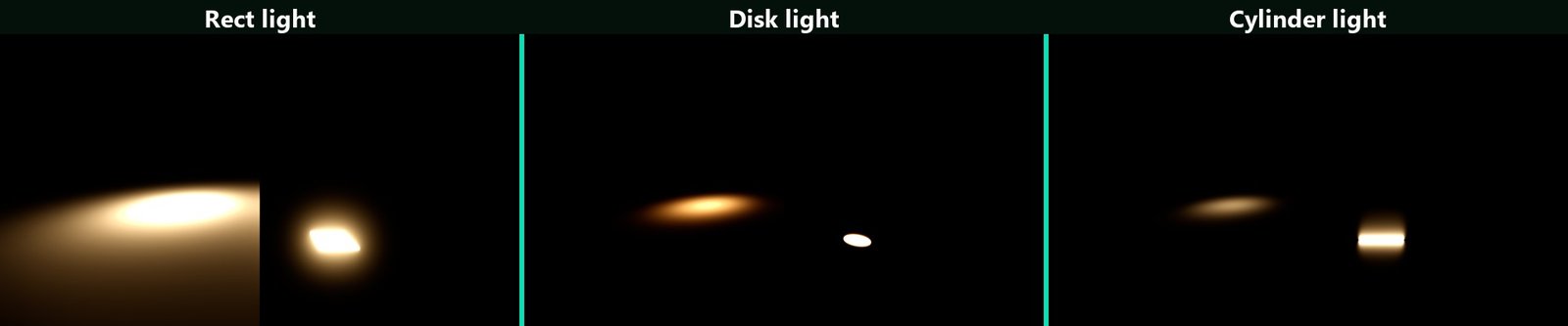
Each light over a rough half (left of each image) and a mirror half (right), default intensity, same exposure. The mirror shows each light's shape; the rough floor shows its spread.
When to use which light
- Point light for a bare bulb, a candle or anything small compared to its distance from what it lights. It is the cheapest local light.
- Spot light for anything that throws light in one direction: torches, headlights, stage lights, and ceiling lights whose light should not reach the ceiling. It is cheaper to shadow than a point light.
- Rect, disk or cylinder light when the emitter is large compared to the distance to the lit surfaces, or when its shape shows in reflections: glossy floors, cars, water. Small or distant area lights look like point lights and only cost more.
All of them share the light properties for colour, intensity, range, shading and shadows.
Intensity
Area lights are set in Lumen (the default in the editor) or Nits, the brightness of the emitting surface. In lumens the light keeps its total output when it is resized, so a larger light has a dimmer surface; in nits the surface keeps its brightness. See Physical Light Units.
Cost
Area lights are more expensive to shade than point and spot lights: every lit pixel evaluates the LTC integral for diffuse and specular light. Like every local light they cost more the more of the screen their range covers, so leave Range on Auto or keep it short, and avoid many overlapping area lights. Use the light count render mode to find hotspots.
Shadows
Area lights cast shadows with CastShadows like the other lights, through a single shadow map with a field of view of about 79° (widened by PenumbraSize) looking along the light's local −X axis. Geometry outside that cone casts no shadow-map shadow:
- A rect or disk light only shadows its front face; the back of a
TwoSidedlight is unshadowed. - A cylinder light emits all around its tube, but its shadow map covers only the 79° cone along −X. Use contact shadows or ray-traced direct lighting for the rest, or leave shadows off.
The shadow edges do not soften with the size of the emitter by themselves; set PenumbraSize for soft edges. Contact shadows and ray-traced direct lighting (see Dynamic Shadows) handle area lights as well. Area lights have no ShadowFadeOutRange: their shadows fade out by the size of their range on screen.
Cookies
Only rect lights take a cookie: a 2D texture, or a decal material rendered into a texture, that colours the light across the rectangle. A video asset as the cookie turns a rect light into a screen that lights the room. See Rect Light Component. Disk and cylinder lights have no cookie.
Point lights are not spheres
Point and spot lights have no source radius or length in rasterised lighting: their highlights are those of a point. For a visible round or tube-shaped highlight, use a disk or cylinder light. Ray-traced direct lighting treats a point or spot light as a small sphere of radius PenumbraSize for its soft shadows.
Orientation
Rect and disk lights emit along their object's local −X axis, the opposite of spot and directional lights, which shine along +X. Rotate the object so that −X points at what should be lit, for example −X pointing down for a ceiling panel.